Lightweight Real-time Speech Noise Reduction Algorithm
Millisecond-level noise reduction, lightweight deployment, and clear voice transmission in full scenarios.
Product InquiryLightweight Real-time Speech Noise Reduction Algorithm
Millisecond-level noise reduction, lightweight deployment, and clear voice transmission in full scenarios.
Product Inquiry1、Product Name & Model
Lightweight Real-time Speech Noise Reduction Algorithm
2、Product Image
Product Picture
3、Application Scenarios
Multi-terminal synchronous noise reduction processing; steady-state noise reduction for dynamic tracking engines, rotors and other noise sources; vehicle/airborne communication systems; tactical noise reduction headsets; helmet-mounted communication units; individual soldier combat communication terminals.
4、Main Purpose
Millisecond-level noise reduction, lightweight deployment, and clear voice transmission in full scenarios.
5、Core Performance
1)End-to-end processing latency: 20–30 ms;
2)Model parameters: ≤ 50K (via knowledge distillation and pruning);
3)Operating power consumption: 65–70 mA;
4)Supported sampling rates: mainstream sampling rates up to 48kHz;
5)Noise suppression capability: ≥35 dB for steady-state noise, ≥25 dB for non-steady-state noise;
6)Hardware adaptation: domestic military-grade chips;
7)Encryption algorithm support: domestic SM4 symmetric encryption algorithm (GB/T 32907-2016).
6、Core Technology & Advantages
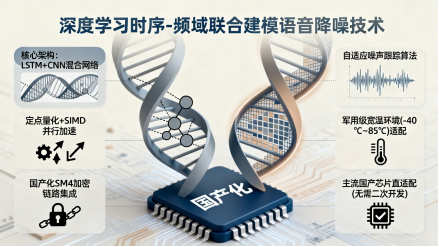
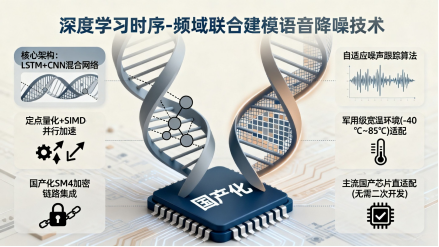
Adopts deep learning time-frequency joint modeling to separate speech from steady-state and non-steady-state noise.A hybrid LSTM+CNN network architecture is applied to capture dual time-domain and frequency-domain features.The adaptive noise tracking algorithm enables dynamic adaptation to complex environments.Fixed-point quantization and SIMD parallel acceleration balance algorithm performance and power consumption.Dual optimization for military-grade requirements and localization: adaptable to a wide temperature range of -40℃~85℃, supports integrated domestic SM4 encrypted links, and is directly compatible with mainstream domestic chips without secondary development.